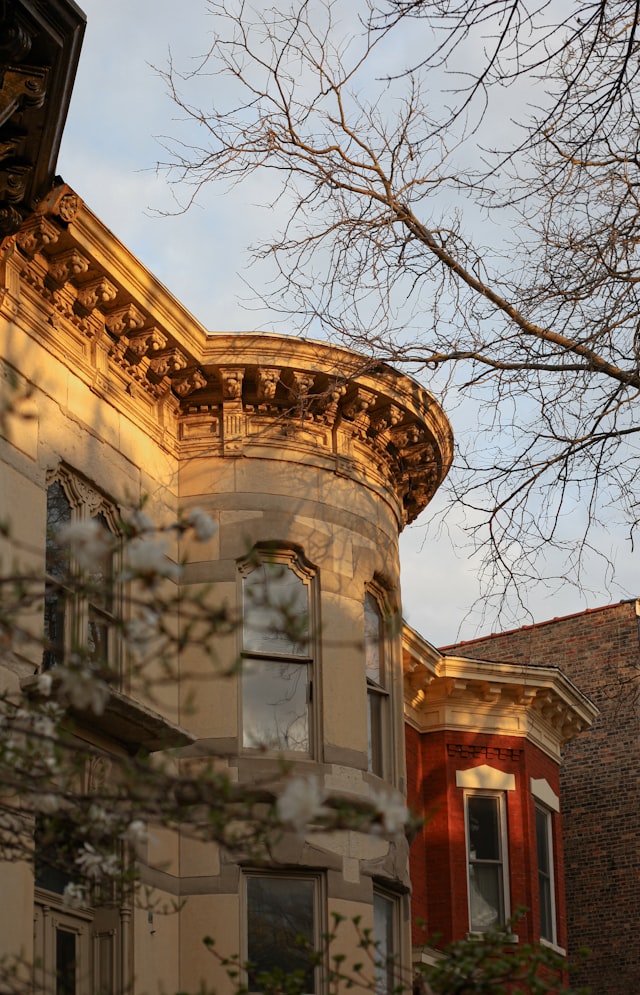
The biggest of Chicago's three sides
Wikipedia calls the South Side the largest of Chicago's three sides, larger in area than the North and West Sides combined. This page covers the community areas Fair Home Cash buys in from Bronzeville (Douglas and Grand Boulevard) and Woodlawn south through Englewood, Chatham and South Shore to Roseland and Pullman, with Back of the Yards, Gage Park and Chicago Lawn on the southwest. Several have their own pages: Englewood, West Englewood, Chatham, Auburn Gresham, South Shore, Roseland, West Pullman, Back of the Yards and Gage Park.
The housing tells the history. Wikipedia notes that by the 1930s more than a quarter of Chicago's residential buildings were under ten years old, many of them bungalows, and that bungalows kept going up on the South Side into the 1960s.
Four housing markets under one name
The Cook County Assessor's 2025 parcel file shows how differently the South Side is built, community area by community area.
The bungalow blocks. Class 2-03, the one-story house of 1,000 to 1,800 square feet, is the biggest residential class in Auburn Gresham (5,076 parcels), Chicago Lawn (4,653), Roseland (4,574) and Chatham (2,504). Chatham also has 418 split-levels (class 2-34). Roseland adds 2,768 smaller one-story homes under 1,000 square feet and 1,784 older two-story houses.
The flats. Buildings with two to six apartments (class 2-11) lead in New City, which takes in Back of the Yards (3,848), Greater Grand Crossing (2,424) and South Chicago (2,324), and Englewood has 2,545.
The condos. Condominium units (class 2-99) are the largest class in South Shore (3,134), Grand Boulevard (2,573) and Douglas (2,442), and Woodlawn has 1,496.
Pullman. The Assessor lists 749 Pullman parcels in class 2-10, the old-style townhouse more than 62 years old, and CMAP counts 43.6 percent of Pullman's housing units as single-family attached homes. The National Park Service describes Pullman National Historical Park as a planned industrial community famed for its urban design and architecture.
Age varies too. CMAP's community snapshots of 2020 to 2024 census estimates put the median housing unit in New City at 1932 and in Greater Grand Crossing at 1937, with more than half of each area's units built before 1940. Roseland's median is 1949, with 53.7 percent of units built from 1940 to 1969, and Chatham's is 1950. The city median is 1953.
Empty lots and empty houses
In Englewood, CMAP's 2023 land use inventory counts 409.7 acres of vacant land, 20.8 percent of the community area and more than the 217.5 acres in single-family homes. The Assessor lists 2,732 Englewood vacant-land parcels, more than its 2,545 two-to-six-flat buildings. New City has 2,135 vacant parcels, and CMAP puts 10.4 percent of its land in vacant use.
Vacant housing units follow the same map. CMAP counts 24.8 percent of Englewood's units as vacant, 18.1 percent of Roseland's, 17.7 percent of Greater Grand Crossing's and Pullman's, and 17.0 percent of Woodlawn's, against 9.1 percent citywide. Ownership splits the other way in places: owners occupy 54.5 percent of occupied homes in Roseland and 53.3 percent in Chicago Lawn, but 25.8 percent in South Shore and 23.9 percent in Woodlawn, against 46.0 percent for the city.
An empty building in Chicago has to be registered with the Department of Buildings within 30 days of becoming vacant or of the owner taking title, whichever is later, and renewed every six months. The Department of Buildings lists a registration fee of $250 to $500, higher if the city has already found the building in violation.
The tax bills that jumped
The Cook County Treasurer's analysis of tax year 2024 bills found the biggest increases on the South and West Sides, where median residential bills rose more than 30 percent in 15 community areas. In five they rose more than 75 percent, and three of those five are on this page's map or next to it: Englewood, West Englewood and West Pullman. Englewood's median homeowner bill went up $609, or 82.5 percent. The same report notes that Englewood's median assessed value had dropped 47.1 percent in the 2021 reassessment. For tax year 2025, billed in 2026, the Treasurer reports the median Chicago homeowner bill rose another 3.2 percent, to $4,597.
The Homeowner Exemption, the Senior Exemption and the Senior Freeze all depend on the owner living in the home, according to the Assessor, so a house that empties out after a death or a move loses them. If taxes go unpaid, the Treasurer's next annual tax sale is December 15, 2026, for delinquent tax year 2023 taxes. Buyers at the sale purchase the debt, not the house, and for a home with one to six units Illinois law (35 ILCS 200/21-350, as amended by P.A. 104-553) generally allows three years from the sale to redeem; vacant non-farm property gets one year. The Cook County Clerk's office prepares an estimate of the cost of redemption.
Prices rose fastest where they were lowest
The same Treasurer report quotes DePaul University's Institute for Housing Studies price index by housing submarket. From 2020 to 2024, prices rose 47.8 percent citywide, and faster in most of the South Side:
- Chicago Lawn, West Englewood, Greater Grand Crossing, Englewood: up 97.03 percent, the most of any Chicago submarket, to a 2024 median sale of $161,000.
- Roseland, Chatham, Pullman, West Pullman and neighbors: up 78.93 percent, median $153,000.
- South Shore, South Chicago, East Side, South Deering, Hegewisch: up 71.22 percent, median $165,000.
- Auburn Gresham, Washington Heights, Morgan Park, Beverly, Mount Greenwood: up 58.27 percent, median $244,000.
- Woodlawn, Hyde Park, Grand Boulevard, Douglas, Kenwood, Washington Park and neighbors: up 43.59 percent, median $530,000.
Those are submarket medians that mix very different buildings, from condos to two-flats. Recent sales of buildings like yours say more than any of them.
Who's buying, and who's in foreclosure
DePaul's 2025 numbers show how much of the South Side market is investors. Business buyers made 43.4 percent of residential purchases in Chatham, 37.0 percent in South Shore, 35.4 percent in Roseland, 33.7 percent in Englewood, 33.1 percent in Auburn Gresham and 31.6 percent in Woodlawn, against 17.3 percent for Chicago and 15.4 percent for Cook County. Chicago Lawn was lower, at 21.9 percent.
Foreclosure filings have been climbing since 2021: in Roseland from 62 to 195 in 2025, in South Shore from 42 to 153, in Chatham from 47 to 116, in Chicago Lawn from 33 to 93, in Woodlawn from 13 to 79 and in Englewood from 36 to 78. Over 2005 to 2023, 57.6 percent of Englewood's residential properties had at least one filing, along with 50.5 percent of Woodlawn's, 43.7 percent of Chicago Lawn's and 41.8 percent of South Shore's, against 20.5 percent countywide. Roseland had 65 completed foreclosure auctions in 2025, and 83.1 percent ended with the lender taking the property.
If you've been served, Illinois law gives you 90 days to reinstate by paying the arrears and costs (735 ILCS 5/15-1602) and a right to redeem until the later of seven months after service or three months after judgment (735 ILCS 5/15-1603), ending before the judicial sale. The Circuit Court of Cook County's Mortgage Foreclosure Mediation Program offers free counseling and legal help at (855) 452-2637. The Cook County foreclosure timeline walks through each stage.
Paperwork on a South Side sale
Water. Every Chicago transfer needs a Full Payment Certificate from the Department of Finance showing the water account is paid. The fee is $50.
Zoning. A residential building with five or fewer units needs a Certificate of Zoning Compliance, which certifies the legal unit count, for a $120 fee. On a two-flat with a garden apartment, that's where the unit count gets settled.
Condos. In South Shore, Bronzeville or Woodlawn condo buildings, Section 22.1 of the Illinois Condominium Property Act requires the seller to make the association's documents available to a buyer, including unpaid assessments, the reserve fund status and planned capital spending. The board has 10 business days to furnish them, and the fee is capped at $375, adjusted for inflation.
Violations and lead. The Department of Buildings posts violations by address on the Chicago Data Portal. A home built before 1978 needs the EPA's lead pamphlet, disclosure of known lead hazards and a 10-day window for the buyer to test, and the Illinois disclosure form asks what you know about lead and basement leaks.
Estates. Cook County probate runs through the Probate Division at the Daley Center. A small estate affidavit can't transfer a house the decedent owned in their own name, per Illinois Legal Aid Online, and with independent administration the representative can sell without a separate court order under 755 ILCS 5/28-8. The probate guide has the steps.
Listing versus selling to Fair Home Cash
A South Side bungalow or condo in good repair can sell well on the open market, and listing may net you more. If that's your house, price it out with an agent first.
The direct sale fits the harder cases: the empty house, the two-flat with a unit the city never approved, the foreclosure case that's moving, the estate whose heirs live out of state, the building the Buildings Department already has a file on. In those cases Fair Home Cash buys South Side houses, flats and condos as-is. If the property is a fit, we make a written cash offer with the math attached. When we buy, we pay the closing costs and the transfer tax, the seller's share included, and the title company pays off the mortgage, back taxes and liens from the proceeds. There's no commission and no repair list, and closing often takes 7 to 28 days once title is clear, on a date you pick. The Chicago page covers the city and the South Suburbs page covers what's past the city line.
Straight answers from Fair Home Cash for South Side sellers
My tax bill nearly doubled. Is that a mistake? Not necessarily. The Treasurer found median bills rose more than 75 percent in five South and West Side community areas for tax year 2024, after values recovered from the 2021 reassessment. You can check your exemptions with the Assessor and your payment status with the Treasurer.
Why do so many companies want to buy my house? In Chatham, DePaul found businesses made 43.4 percent of 2025 residential purchases. Your address is in public records. Get offers in writing and compare at least two.
The house next door is vacant. Does that change what I can sell for? It can matter to a financed buyer's appraiser. A cash buyer prices your house as it is.
Sources: Wikipedia, South Side, Chicago; Cook County Assessor parcel universe, tax year 2025; Cook County Assessor, residential classification examples; CMAP Community Data Snapshot, Englewood; CMAP, New City; CMAP, Greater Grand Crossing; CMAP, Roseland; CMAP, Chatham; CMAP, Pullman; CMAP, Woodlawn; CMAP, South Shore; CMAP, Chicago Lawn; National Park Service, Pullman National Historical Park; Chicago Department of Buildings, vacant buildings; Cook County Treasurer, tax year 2024 bill analysis; Cook County Treasurer, tax year 2024 bills (Nov. 17, 2025); Cook County Treasurer, tax year 2025 bill analysis; Cook County Assessor, exemptions; Cook County Treasurer, due dates and tax sale; 35 ILCS 200/21-350; Cook County Clerk, tax redemption; DePaul Institute for Housing Studies: Chatham, South Shore, Roseland, Englewood, Auburn Gresham, Woodlawn, Chicago Lawn, Chicago, Cook County; 735 ILCS 5/15-1602; 735 ILCS 5/15-1603; Circuit Court of Cook County, foreclosure mediation; City of Chicago, Full Payment Certificates; City of Chicago, Certificate of Zoning Compliance; 765 ILCS 605/22.1; Chicago Data Portal, Building Violations; EPA, lead disclosure rule; 765 ILCS 77/35, Illinois disclosure form; Circuit Court of Cook County, Probate Division; Illinois Legal Aid Online, small estate affidavit; 755 ILCS 5/28-8
