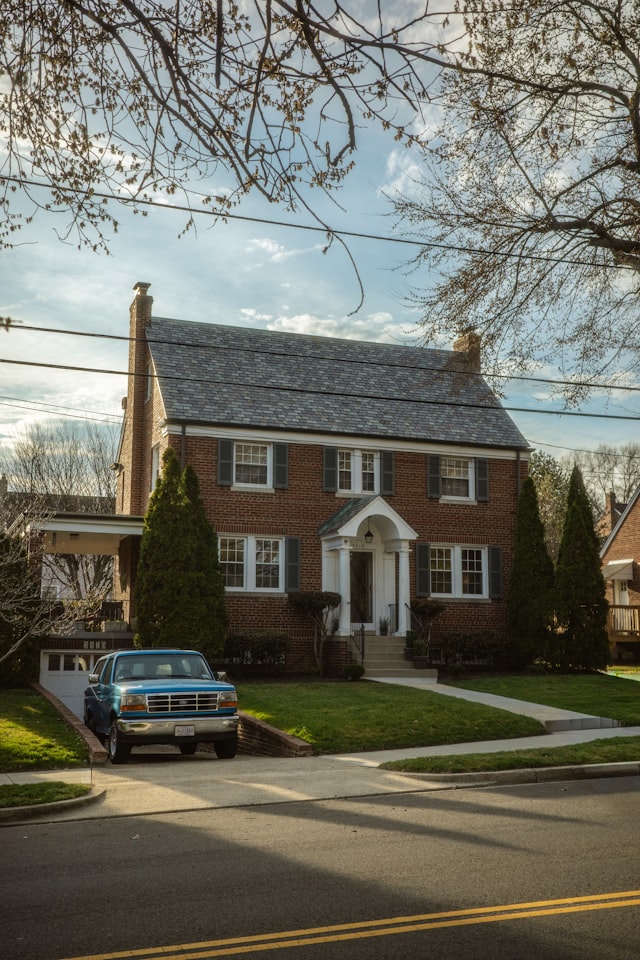
A bigger house just means a bigger tax bill
People assume a Naperville address protects you. It doesn't. It just makes the bills larger. On a typical $480,000 house here, property taxes run over $900 a month before you've paid a dime toward the mortgage. School levies are a big part of these bills, and those rates aren't coming down. So when a layoff or a medical thing or a divorce knocks out the income, the bills don't care how much equity you're sitting on. Equity is not cash flow: a couple hundred thousand in paper equity does nothing for a $900 monthly tax bill that is due whether or not you have a plan yet.
Foreclosure at this price point
The court process in DuPage County often takes about a year to eighteen months from filing, as it does across Illinois, because the lender has to sue before they can sell. There's a redemption window before the court sale, but keeping the house through it means paying off the entire loan balance, which almost nobody in trouble can do. You can still sell the house yourself until that window ends. If you want a number that reflects what the house is really worth, though, sell early, before fees and interest pile onto the case.
Houses from the 80s and 90s all need the same things at once
A huge share of Naperville got built in the 80s and 90s, and those houses are hitting their first big replacement cycle together. Original furnace. Roof on borrowed time. An electrical panel the insurance company doesn't like. At this price point buyers often need jumbo loans, and those lenders are picky about condition. If you can't front $20,000 to $40,000 of work before listing, your buyer pool gets thin in a hurry. Springbrook, Wheatland, and the outer west subdivisions are full of that vintage. A cash buyer doesn't need anything fixed before closing.
A house that needs work is a different market
Move-in-ready houses move fast and get top dollar, no question. A house that needs work is a different story. Buyers inspect hard, negotiate every line item, and walk away from anything that smells like a project, because they have plenty of cleaner houses to pick from. If your place needs work, the inspection contingency is what kills the deal, usually three or four weeks in, after you've already mentally moved out. We don't walk over a long inspection report. Honestly, the report is kind of our whole business.
What it costs to sell the normal way
On a $480,000 house the friction is enormous. Commission alone is about $23,500 at the Illinois average of 4.9%. Add closing costs, concessions, and months of carrying costs, and an agent sale usually takes 7 to 8% of the price, about $34,000 to $38,000 here, before the repair work a 90s house needs. People hear the high sale price and assume they're safe, then do the real math and feel sick. A cash sale wipes out every one of those line items. You close on your schedule, you keep what you keep, and you're done. The earlier you decide, the more there is left to keep.
What the census says about Naperville's houses
CMAP's June 2026 Community Data Snapshot for Naperville, built on 2020 to 2024 American Community Survey estimates, counts 54,847 occupied homes and 2,288 vacant ones, a 4.0 percent vacancy rate. Owners occupy 74.8 percent of occupied homes, down from 79.7 percent in 2000 as apartments went up; buildings of 20 or more units are now 7.8 percent of the stock, two-flats 1.0 percent, single-family detached houses 62.8 percent.
The age profile is the opposite of Joliet's or Elgin's. CMAP counts only 1,419 units, 2.5 percent, built before 1940 and 8.4 percent from 1940 to 1969. The bulk is 39.9 percent from 1970 to 1989 and 41.2 percent from 1990 to 2009, with 8.0 percent built since 2010, and the median year built is 1990 against DuPage County's 1978. That 1970 to 1989 band, 22,777 houses, is the one hitting its second roof and third furnace now. Median household income is $155,105, against $112,096 for DuPage County and $93,091 for the seven-county region. CMAP's 2023 land use inventory shows just 517.8 acres of vacant land, 2.0 percent of the city, and the Illinois Department of Revenue's 2024 figures in the same snapshot put residential property at $8.14 billion of the city's $9.86 billion equalized assessed value.
Wikipedia lists Naperville in DuPage and Will counties with a 2020 census population of 149,540, fourth in Illinois. Joseph Naper founded it in 1831 on the DuPage River; it had 12,933 people in 1960, 85,351 in 1990 and 128,358 in 2000, which is the growth the housing age table shows. The Riverwalk, begun in 1981 for the city's 150th anniversary, runs 1.75 miles through downtown past North Central College, founded in 1861. Two school districts cover the city, Naperville Community Unit District 203 and Indian Prairie District 204. The largest employers, per the same page, are Edward Hospital (4,500), Nokia (2,750), BP America (1,200) and Nalco (1,200), and Metra's BNSF line stops downtown and at Route 59.
DuPage County's 2026 calendar, and Will's
The DuPage County Treasurer mailed 321,773 bills on April 29, 2026, due June 1 and September 1, 2026, on a levy of $3,756,793,481. The Treasurer's tax sale page says an installment still delinquent on October 2, 2026 goes into the delinquent publication the week of October 12, the full amount must be in the office by 4:30 p.m. on November 18, and the sale runs at 9 a.m. on November 19, 2026, and the 20th if necessary, at 421 North County Farm Road in Wheaton. Bidding begins at 9 percent; at the November 2025 sale the average winning bid was 2 percent per six-month redemption period for most parcels, and the page gives the owner a 2 to 2.5 year redemption period depending on the property's classification. A 2026 change in state law (P.A. 104-553) gives homes sold at the November 2026 sale 3 years.
The Will County side of Naperville runs on the Will County Treasurer's schedule: payments posted by 4:30 p.m. on November 30, 2026 to avoid the December 1, 2026 sale. For a home sold at that sale, Illinois law now gives 3 years to redeem (35 ILCS 200/21-350, as changed by P.A. 104-553). The DuPage County foreclosure timeline and the Will County foreclosure timeline cover the lender's side, and the back-taxes guide covers the tax sale.
Paperwork on a Naperville sale
The buyer pays the city stamp. Naperville's real estate transfer tax page says buyers of residential or commercial property inside city limits are responsible for the stamp, by ordinance, at $1.50 per $500 of purchase price with the price rounded up to the next $500 (its own example rounds $150,437 to $150,500). On a $480,000 house that is $1,440, paid by the buyer, not you. A statement of open accounts has to be requested at least 7 business days before closing, with a signed sales document and a copy of the deed, and there is no charge for an exempt stamp. Chicago Title's July 1, 2026 chart adds that since a 2010 ordinance every fee or debt owed to the city must be paid before the stamp issues, and that the city now issues digital stamps that attach to the deed. The seller still owes DuPage County's $0.25 per $500 ($240 on $480,000) and the state's $1 per $1,000 ($480), filed through MyDec, which the chart says every DuPage County transaction uses.
Lead and disclosure. The EPA's pre-1978 lead rule reaches fewer houses here than in the older towns, but CMAP still counts 10.9 percent of Naperville's homes built before 1970, plus the 1970 to 1977 slice on top. The Illinois disclosure form (765 ILCS 77/35) asks about the roof, the basement, the wiring and the plumbing.
Foreclosure. If you've been served, Illinois law gives you 90 days to reinstate by paying the arrears and costs (735 ILCS 5/15-1602) and a right to redeem until the later of seven months after service or three months after judgment (735 ILCS 5/15-1603), ending before the judicial sale.
Estates. An inherited house in the decedent's own name cannot pass by small estate affidavit, per Illinois Legal Aid Online; with independent administration the representative can sell without a separate court order under 755 ILCS 5/28-8. The probate guide has the steps.
Listing versus selling to Fair Home Cash
A Naperville house in good repair will usually net more on the open market than from any cash buyer. Price it with an agent first.
The direct sale fits the harder cases: the 1978 house with the original roof and furnace and a jumbo-loan buyer pool that won't finance it, the divorce where the house has to be gone by a court date, the estate with heirs out of state, the tax bill heading for the November sale. In those cases Fair Home Cash buys Naperville houses as-is. If the property is a fit, we make a written cash offer with the math attached. When we buy, we pay the closing costs and the transfer tax, the seller's share included, and the title company pays off the mortgage, back taxes and liens from the proceeds. There's no commission and no repair list, and closing often takes 7 to 28 days once title is clear, on a date you pick.
Straight answers from Fair Home Cash for Naperville sellers
Do I pay Naperville's transfer tax? No. The city's page puts the stamp on the buyer at $1.50 per $500. The seller's transfer costs are the county's and the state's, which Fair Home Cash pays when we buy.
Why is my tax bill so high when DuPage's rates are lower than Cook's? DuPage's 2025 levy was $3.76 billion across 321,773 bills (DuPage County Treasurer), and residential property carries 82.5 percent of Naperville's equalized assessed value (Illinois Department of Revenue, via CMAP). A high-value house pays a high bill even at a moderate rate.
Which county am I in? Naperville spans DuPage and Will (Wikipedia). The bill names the county, and that sets the due dates, the tax-sale date and the courthouse.
Sources: CMAP Community Data Snapshot, Naperville (June 2026); Wikipedia, Naperville, Illinois; DuPage County Treasurer; DuPage County Treasurer, tax sale information; Will County Treasurer; City of Naperville, real estate transfer tax; Chicago Title, transfer taxes, Chicago metropolitan area (July 1, 2026); EPA, lead disclosure rule; 765 ILCS 77/35; 735 ILCS 5/15-1602; 735 ILCS 5/15-1603; Illinois Legal Aid Online, small estate affidavit; 755 ILCS 5/28-8
