Belmont Central, Cragin, Hanson Park and the Brickyard
Belmont Cragin is Chicago's Community Area 19, about eight miles northwest of the Loop and just under four square miles in size. It borders Portage Park, Hermosa, Austin, Montclare and Dunning. It's really four neighborhoods: Belmont Central, built around the shopping district that grew up along Belmont Avenue in the 1920s; Cragin; Hanson Park; and the Brickyard, where the Brickyard Shopping Mall opened in 1977 on the old Carey Brickyard site and was torn down in 2003 for big-box stores. Metra's Grand/Cicero station replaced the old Leclaire Avenue stop in 2006.
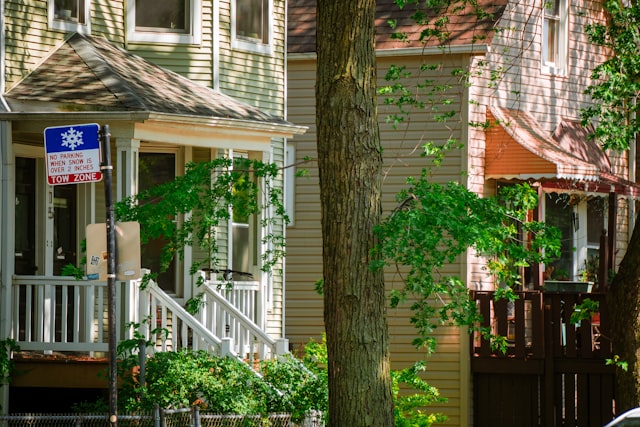
Builders put up bungalows, Cape Cods and two-flats here. That mix is still what you see.
Bungalows and two-flats, side by side
The Cook County Assessor's 2025 parcel file lists 5,527 Belmont Cragin parcels in class 2-03, the one-story house of 1,000 to 1,800 square feet, and 3,849 parcels in class 2-11, buildings with two to six apartments. Behind those come 1,415 small one-story homes under 1,000 square feet (class 2-02), 614 condominium units, 446 older two-story houses (class 2-05), 425 larger one-story homes (class 2-04) and 392 storefront buildings with apartments (class 2-12). Only 77 parcels are vacant land, so this is a fully built-out neighborhood.
CMAP's community snapshot of 2020 to 2024 census estimates puts 40.2 percent of housing units in detached houses, against 25.6 percent citywide. Two-unit buildings hold 25.5 percent and three- and four-unit buildings 17.2 percent, while only 3.7 percent sit in buildings of 20 or more units (27.0 percent citywide). The median unit was built in 1936, against 1953 for the city, and 54.0 percent predate 1940. DePaul University's Institute for Housing Studies counts 41.2 percent of residential properties as two-to-four-unit buildings and 37.9 percent as single-family homes.
Owners, bedrooms and vacancy
Belmont Cragin is one of the city's larger communities, at 72,088 residents in CMAP's count. About 6.7 percent of homes have five or more bedrooms. Owners live in 52.3 percent of occupied homes, above the city's 46.0 percent, and vacancy is a low 6.5 percent of units. The median household income is $68,284.
Many houses here carry the same additions: a finished attic, a bedroom or a whole unit in the basement, an enclosed back porch, a second kitchen. When the house sells, the question becomes which of those changes went through the city.
The foreclosure wave, then and now
In 2010, DePaul counted 901 new foreclosure filings on Belmont Cragin residential property, far more than Portage Park's 571 or Humboldt Park's 562 that year. Over 2005 to 2023, 35.1 percent of residential properties here had at least one filing, against 20.5 percent for Cook County. Filings bottomed out at 20 in 2021 and rose to 70 in 2025. Six foreclosure auctions were completed in 2025, and five ended with the lender taking the property.
If you're behind now, the Illinois foreclosure statute gives you 90 days from being served to reinstate by paying the arrears and costs. If the court finds you did reinstate, you can't use that right again on the same mortgage for five years. Your right to redeem runs until the later of seven months after service or three months after judgment, and it ends before the judicial sale. The Circuit Court of Cook County's Mortgage Foreclosure Mediation Program offers free counseling and legal help to anyone who has been served; call (855) 452-2637. A sale before the judicial sale pays the lender off at closing and lets you keep the rest. The Cook County foreclosure timeline shows each stage.
Sales and buyers in 2025
DePaul counted 336 residential sales in Belmont Cragin in 2025, down from 571 in 2021. Business buyers made 18.2 percent of residential purchases, a bit above the county's 15.4 percent, and 15.5 percent of single-family purchases. Most buyers here are households rather than companies, and a buyer with a mortgage brings an appraisal and an inspection into the deal.
What gets checked before a Belmont Cragin closing
The unit count. Chicago requires a Certificate of Zoning Compliance when a residential building with five or fewer units is sold. It certifies how many dwelling units are legal, and the filing fee is $120. On a two-flat with a garden apartment, or a bungalow with a basement unit, this certificate settles what the buyer is actually getting.
The water account. A Full Payment Certificate from the Department of Finance, showing the water bill is paid, has to come before the city issues transfer stamps. The fee is $50.
Violations. The Department of Buildings posts every violation on the Chicago Data Portal by address, with inspector comments. A permit problem on an enclosed porch or a basement conversion will be there.
Lead and disclosure. Roughly four in five units here predate 1970 in CMAP's age table, so most sellers owe the EPA's lead pamphlet, disclosure of known lead hazards and a 10-day window for the buyer to test. The Illinois disclosure form asks what you actually know, including lead pipes and basement leaks, and allows an as-is sale.
Taxes and exemptions
The Cook County Treasurer reported that the median Chicago residential tax bill for tax year 2024 rose 16.7 percent, to $4,457. The Assessor's Homeowner Exemption, and the Senior Exemption for owners 65 and up, apply only when the owner lives in the home as a principal residence. If a parent who carried those exemptions has died or moved out, they no longer fit.
If taxes are behind, the Treasurer's next annual tax sale is December 15, 2026, for delinquent tax year 2023 taxes. Buyers at that sale purchase the tax debt, not the house. A home with one to six units generally has three years from the sale to redeem under 35 ILCS 200/21-350 (as amended by P.A. 104-553), and the Cook County Clerk's office will prepare an estimate of the cost of redemption.
When the house passes to the next generation
Cook County estates go through the Probate Division of the Circuit Court at the Daley Center. If the house was in the decedent's name, a small estate affidavit won't transfer it, according to Illinois Legal Aid Online. Once a representative is appointed with independent administration, Illinois law (755 ILCS 5/28-8) lets them sell real estate without a separate court order, unless the will specifically left the house to someone, who must consent in writing. If a sibling or cousin is living in the house, settle who's staying and who's selling early. The inherited house guide has the steps.
Two ways to sell
A Belmont Cragin bungalow or two-flat in good condition, with permits that match the floor plan, sells to buyers with loans, and listing may net you more. If that's your house, list it.
When the basement unit isn't legal, the foreclosure case is moving, the house needs a roof and a furnace, or the family can't agree on fixing it up, Fair Home Cash buys Belmont Cragin houses and flats as-is. If the property is a fit, we make a written cash offer with the math attached. When we buy, we pay the closing costs and the transfer tax, the seller's share included. There's no commission, no repairs and no showings, and closing often takes 7 to 28 days once title is clear, on a date you pick. Nearby pages cover Portage Park, Humboldt Park and Austin, and the Chicago page covers the city.
Straight answers from Fair Home Cash for Belmont Cragin sellers
We added a bedroom in the basement without a permit. Do we have to disclose it? The Illinois form asks about material defects you know of. Talk to your attorney about how to answer. A cash buyer will price the house with the basement as it is.
We reinstated our mortgage once before. Can we do it again? Not if the court made a written finding that you reinstated in the last five years on the same mortgage. Redemption and a sale are still options.
Do investors pay less than owner-occupants? Usually, because they're buying the repairs too. The trade is speed, certainty and no repair list. Compare written offers and decide with the numbers in front of you.
Sources: CMAP Community Data Snapshot, Belmont Cragin; Cook County Assessor parcel universe, tax year 2025; Cook County Assessor, residential classification examples; DePaul Institute for Housing Studies, Belmont Cragin; DePaul Institute for Housing Studies, Cook County; Wikipedia, Belmont Cragin, Chicago; 735 ILCS 5/15-1602; 735 ILCS 5/15-1603; Circuit Court of Cook County, foreclosure mediation; City of Chicago, Certificate of Zoning Compliance; City of Chicago, Full Payment Certificates; Chicago Data Portal, Building Violations; EPA, lead disclosure rule; 765 ILCS 77/35, Illinois disclosure form; Cook County Treasurer, tax year 2024 bills; Cook County Assessor, exemptions; Cook County Treasurer, due dates and tax sale; 35 ILCS 200/21-350; Cook County Clerk, tax redemption; Circuit Court of Cook County, Probate Division; Illinois Legal Aid Online, small estate affidavit; 755 ILCS 5/28-8
